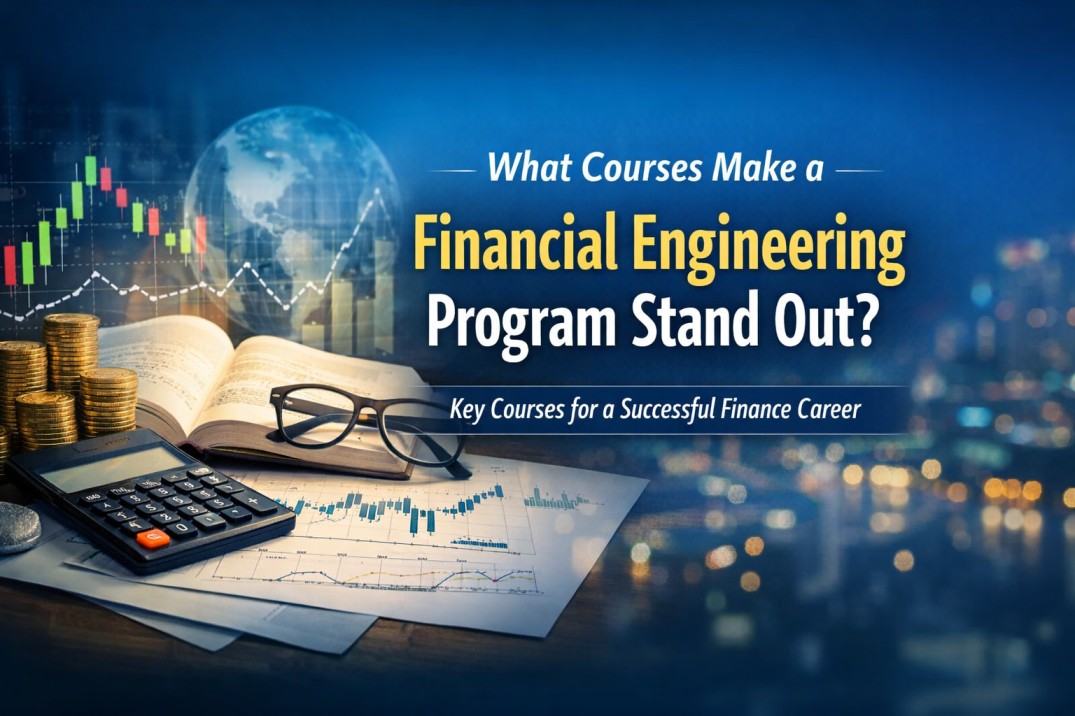
What Courses Make a Financial Engineering Program Stand Out
Quantitative Finance is one of the fields of financial practice that most utilizes techniques of mathematics, statistics, and financial theory, which is why when researching various fields of study, you may have come across the term Financial Engineering Program. However, not all of them are the same. What makes one program better than its counterparts?
Some programs are structurally designed to teach more theory than others and vice versa. It all depends on the courses that the program offers. The right balance of courses can mold you to become the kind of problem solver that the financial markets demand.
We can analyze what courses should be present in order for a Financial Engineering Program to be considered good.
Essential Courses that are the Hallmark of any Financial Engineering Program
Good programs focus on building a strong foundation. The following courses are required:
-
Mathematics for Finance
Linear algebra, calculus, and probability will be on the syllabus. These are not just academic exercises; they will be used in the practice of modeling and risk analysis.
-
Statistics and Data Analysis
Data is of utmost importance in any analysis. You will be trained in data interpretation, trend analysis, hypothesis testing, and in making decisions based on data.
-
Financial Markets and Instruments
This course will familiarize you the with the functionality of stocks, bonds, and derivatives as well as the general functioning of the markets.
With the knowledge of these fundamentals, you will be able to move with more certainty.
Advanced Courses That Make Financial Engineering Programs Unique
Now for the real differentiators. These are the courses that separate good programs from great ones.
-
Derivative Pricing and Modeling
How to price complex instruments like options and futures. This is crucial for trading and risk management roles.
-
Stochastic Calculus
It may sound intimidating, but it is used to model random movements in a market. It is a common tool in quant finance.
-
Risk Management
This course covers the measurement and management of financial risks including credit, market, and operational risks.
-
Machine Learning in Finance
Algorithms dominate modern finance. Programs with embedded AI and machine learning components put you ahead of the competition.
These courses prepare you for the real world, along with the theoretical components.\
Learning Through Practice
Many programs fail here. A leading Financial Engineering Program goes beyond the textbook.
Look for:
- Capstone Projects
real-world projects where you solve actual financial problems.
- Internships or Industry Collaborations
These exposed you to the inner workings of banks, hedge funds, or fintech firms.
-
Programming Courses (Python, R, C++)
Coding is an essential skill. It is needed for modeling, automation, and analysis.
Your knowledge needs to be applied, and practical experience is what helps to do this.
Interdisciplinary Courses Add Value
The best programs understand that finance exists alongside other disciplines.
These fields can be quite impactful:
-
Economics – Comprehend the macro level reasoning behind the fluctuations of the market.
-
Computer Science – Enhance your practical and algorithm-based reasoning.
- Behavioral Finance – Comprehend the market from a psychological standpoint.
Helping you to make better and more informed decisions is this wider viewpoint.
Soft Skills and Communication Matter Too
Not having technical skills is actually more surprising.
The top programs offer
-
Financial Communication Simplified communication of complex notions is an important skill.
-
Ethics in Finance It is important to understand the ethical implications in today's finance world.
These skills allow you to differentiate yourself in interviews and at work.
Conclusion
Skill-shaping courses, instead of rankings, determine the best Financial Engineering Programs.
The top programs integrate:
-
Solid grounding in math and finance
-
Cutting-edge and relevant topic coverage
-
Practical learning
-
Multi-disciplinary integration
-
Coaching and ethics
With these program features, you won’t just learn, you will be equipped for a winning career in finance.
FAQs
1. What is the most important course in a Financial Engineering Program?
There is no single answer, however, for practical applications, derivative pricing and risk management are seen to be the most important.
2. Do I need programming skills for financial engineering?
Yes. Data analytics and financial modeling at a practical level are done in languages like Python and R.
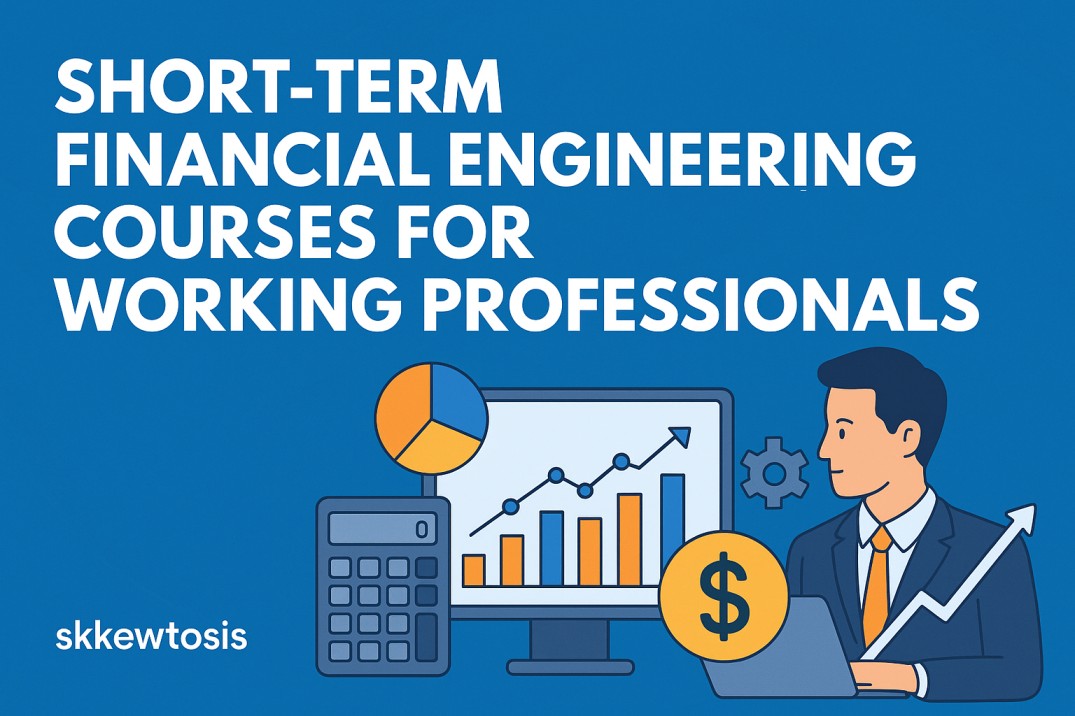
Read More: Short-Term Financial Engineering Courses for Working Professionals







.jpg)
.jpg)
.jpg)
.jpg)
.jpg)