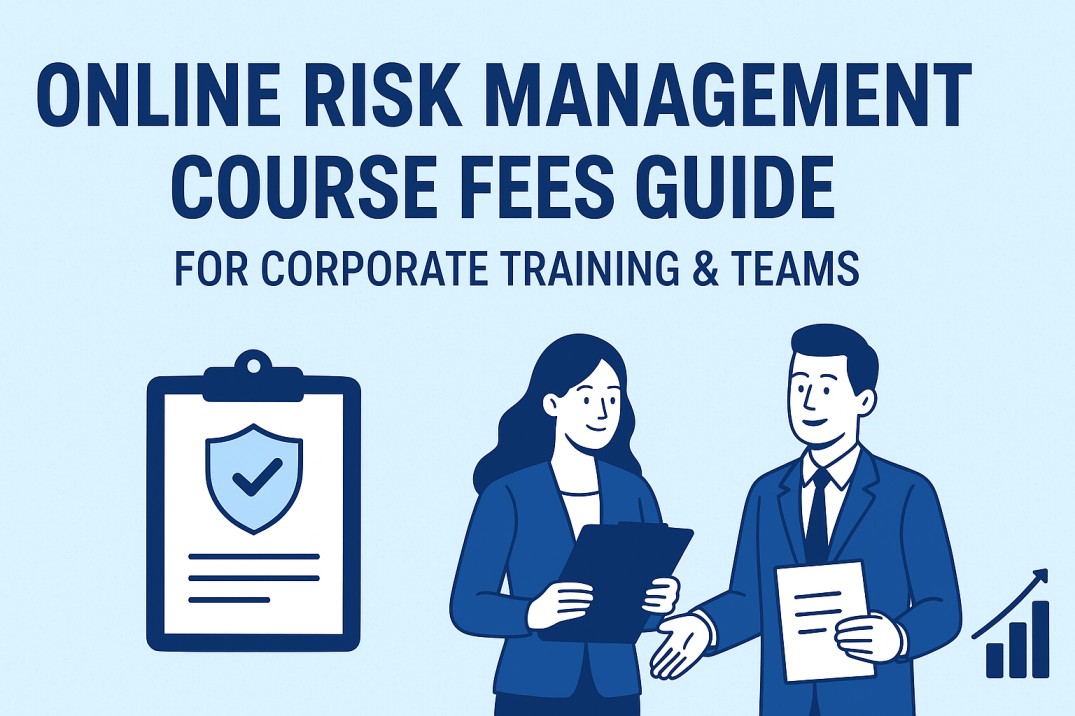
Online Risk Management Course Fees Guide for Corporate Training & Teams
As organizations confront growing market unpredictability, regulatory challenges, cybersecurity risks, and operational challenges, the ability to manage risk has become critical for all functions of the business. For corporate teams, the integration of online risk management training has become a strategic imperative to enrich decision-making, compliance, and organizational sustainability.
However, the abundance of training providers and course formats has led corporate organizations to questions such as: What is the cost of online risk management training accessible to organizations?
This guide outlines the average risk management training fees, factors affecting these fees, and cost-saving strategies for organizations training one employee, or all members of a corporate team.
- Typical Pricing for Online Corporate Risk Management Courses
What follows is a general pricing range for companies looking into training for entire teams:
? Beginner Courses (Basics & Foundations)
Price: ?3,000 – ?12,000 per employee
Target audience: Junior employees, analysts, operational staff
Topics: Risk basics, framework, first exposure to compliance, basic compliance tools
? Intermediate Courses (Application & Practical Training)
Price: ?15,000 – ?40,000 per employee
Target audience: Team members, Heads of Departments
Topics: Operational risk, financial risk, risk framework of ORM, scenario planning, risk mitigation strategies
? Advanced Corporate Programs (Certification & Specialization)
Price: ?45,000 – ?1,50,000 per employee
Target audience: Executives, Risk Managers, Lead Analysts
Topics: Enterprise risk, quantitative models, compliance systems & framework, strategic risk management
? Tailor-Made Corporate Training Programs
Price: ?1,00,000 – ?10,00,000+ (per Team)
Target audience: Corporate clients needing custom training
Includes:
Company-specific risk modules
Live workshops
Industry-specific risk training
Analytics & reporting dashboards
Facilitated remote training sessions
-
Elements that Influence Risk Management Course Fees
-
Curriculum's Range & Difficulty
Courses that include topics such as credit risk, cyber risk, or enterprise risk, as well as other advanced topics, overall tend to be more expensive than the basic ones.
- Learning Format Options
- Most affordable
- Self-paced
- Online
- Most expensive
- Live instructor-led training
- Moderate cost
- Highly effective for teams
- Hybrid model
- Class Size and Corporate Volume Discounts
- Group discounts
- Most providers offer
- Bulk licensing
- Annual corporate subscriptions
- Certifications and Testing
- Programs that include
- Certification exams
- Assessments
- Badges
- Generally have higher fees
- Reputation of Training Platforms
- Well-known risk academies
- Global institutes
- Universities
- Usually charge premium
- Why Companies Should Invest In Risk Management Training
- Strengthens the Organizational Resilience
- Trained teams
- Respond better to crises
- Mitigate losses
Ensures Compliance and Reduces Penalties
- Employees
- Understand regulatory obligations
- Industry standards
• Enhances Strategic Decisions
- Risk aware teams
- Make smarter
- Data driven decisions
- Improves Operational Efficiency
- Knowledge of risk frameworks
- Increases productivity
- Reduces disruptions
- Boosts efficiencyIncreases agility
- Minimizes downtime
- How to Choose the Right Corporate Risk Management Course
When choosing a training program, companies should consider the following:
- Curriculum relevance to the industry
- Manual and technical scholar credentials
- Pedagogical value of the training
- Consideration of the training
- HR and L&D analytics reporting
- Skill and performance value of training
Frequently Asked Questions
- What is the best-suited course for corporate customers?
The best-suited course is self-paced with the addition of live sessions from experts for larger teams to enable flexibility, and for the course to reach the desired objectives.
- Do companies receive discounts for bulk purchases?
Yes, publishers consider volume purchases and offer corporate bundles or enterprise licenses.
- Is it possible for employees to learn risk management even if they have no prior experience?
Yes, definitely. Newcomers are encouraged to either take basic courses first or to engage in entry-level subject courses, and later, more experienced courses.
- How much time is allocated for training in corporate risk management?
Training and course length can range from 10 hours to 12 weeks, depending on the scope and detail.
- Which industries / sectors benefit the most from training in risk management?
Risk Management Courses is mainly beneficial in the following industries: Banking, Finance, Insurance, IT, Manufacturing, Supply Chain, Consulting and even in Government departments.
Read More: Best Quantitative Finance Courses: A Complete Guide


.jpg)
.jpg)
.jpg)
.jpg)
.jpg)