Short-Term Financial Engineering Courses for Working Professionals
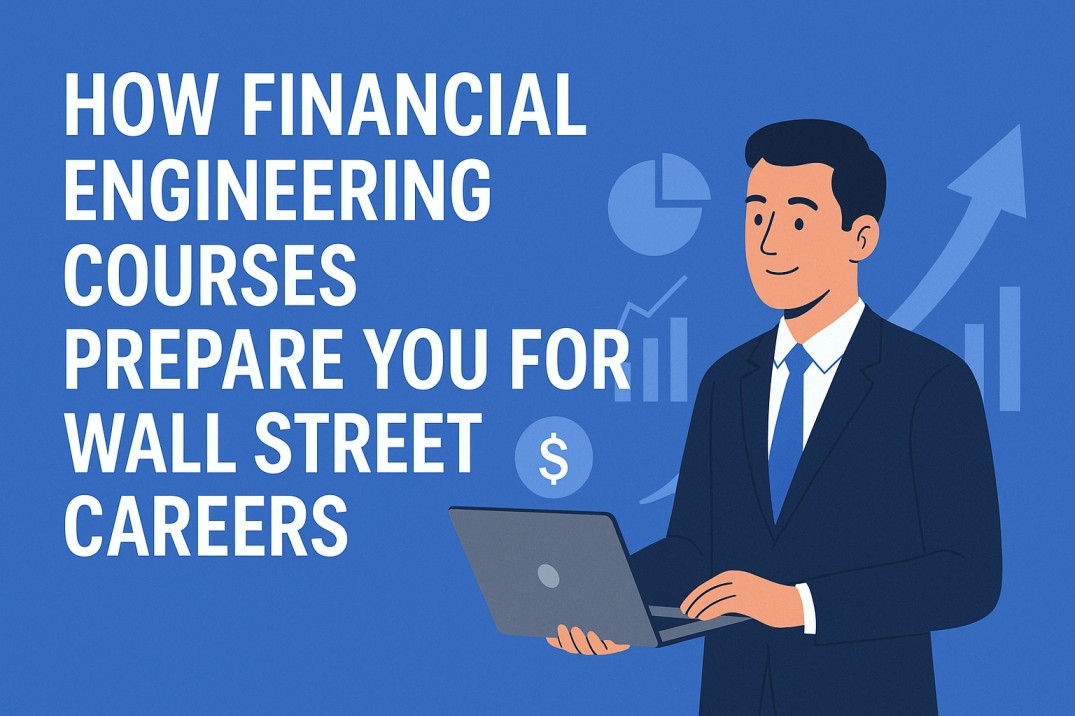
To keep up with the competition, working professionals from Banking, Investment Management, Risk Management, Corporate Finance, etc, are turning to short term financial engineering courses. They offer practical, relevant, and flexible financial engineering training, which doesn't require students to quit their jobs. If you are considering careers in quantitative finance, or if you are looking to enhance your analytical and/or risk management skills, these short courses are great options. They are timely and perfect for your needs.
Financial engineering is the use of mathematical modeling and the tools of data analysis, statistics, and computing to address problems in finance. Until the last few decades, this field was specialized and very few people entered it. Today, however, financial engineering is in demand in almost every sector, including FinTech, Investment Banks, Hedge Funds, Rating Agencies, and Advisory Firms. This has prompted many Universities to create short programs to help working professionals acquire these skills in a matter of weeks/months.
Why short duration courses are ideal
Flexibility
Most programs offer online courses on weekends or in the evenings, allowing learners to study without upsetting their work-life balance. This means that you can upskill yourself without hindering your progress at work.
Skill Development Relevant to The Industry
Short financial engineering classes develop skills that are vital in areas such as pricing derivatives, constructing financial models, programming in Python (or R), managing risks, and optimizing portfolios.
Shorter, Cheaper, and More Efficient
Shorter programs are more cost-effective and time efficient, which is excellent for motivated individuals, as opposed to full time master's programs.
Mobility in One's Career
As data-driven decision making enters the mainstream in various sectors, the demand for financial engineers is skyrocketing, allowing for positions such as quantitative analyst, risk analyst, trader, and financial modeler.
Common Subjects in Financial Engineering Courses
- Basics of Quantitative Finance
Investments, financial markets, and stochastic processes are just some of the areas covered.
- Pricing Derivatives and Risk
Concepts and models such as the Black-Scholes model, Greeks, and Monte Carlo simulations are covered in this Investment Banking Risk course.
- Financial Programming in Python
Due to Python's heavy utilization in the field, courses lead to the construction of financial models which are used in quant as well as fintech.
- Finance Related to Machine Learning
This involves predictive modeling, and the use of ML in constructing trading algorithms and optimizing portfolios.
- Techniques for Managing a Portfolio
Learners are taught to use quantitative approaches for asset allocation, building a portfolio, and for the use of factor models.
Websites like skkewtosis offer insights, comparisons, and suggestions on financial engineering courses, allowing professionals to determine which option best fits their career goals.
Benefits for Working Professionals
Short-term programs in financial engineering provide you with the up-to-date analytical and modelling skills required to work with complex financial products and make data-driven decisions. Some participants report the following immediate career benefits: increased confidence with their analytical skills, improved interviewing skills, and enhanced credibility within their organization.
Moreover, employers prefer candidates with the skills to communicate quantitative results and work collaboratively with data science teams. Therefore, obtaining training in financial engineering is likely to positively impact the growth of your career.
FAQs
- Who is the best fit for a short financial engineering program?
Bankers, finance graduates, analysts, risk managers, professionals in fintech, and those moving into a different role in quantitative finance.
- Is a strong math background required?
For the best results, a basic knowledge of statistics and mathematics is useful. Foundation modules are provided in some courses.
- Is a career switch possible with course completion?
Yes. Many learners complete short programs to secure roles in quantitative finance, risk management, or financial modelling.
- Are online courses effective?
Most definitely. Many online courses include live classes, coding exercises, practical projects, and instructor assistance.

.jpg)
.jpg)
.jpg)
.jpg)
.jpg)