The Role of Certification in Advancing Your Banking Risk Career
Risk management is one of the important functions to ensure financial stability and compliance in the banking sector. The growing complexity of markets and the evolving nature of regulations demand that banking professionals acquire sound risk management skills and expertise. Having a professional risk management certification will allow you to gain a competitive advantage and further your career in banking.
Why Certification is Important in Banking Risk Management
Beyond being a credential, the certification you achieve is a culmination of your effort toward attaining quality expertise, establishing your credibility, and achieving professional rigor. Having a certification in risk management improves your reputation and showcases your ability to handle risks in a manner that meets the needs of the banking sector.
- Indicates Specialized Knowledge
With certification, you gain a comprehensive understanding of the different types of risks, including credit, operational, market, as well as the pertinent regulatory frameworks. This knowledge equips you to make decisions and craft effective risk management plans.
- Boosts Career Mobility
Because of certification, professionals get access to management and specialized positions like Risk Analyst, Compliance Officer, Credit Risk Manager, and Chief Risk Officer. Certified professionals working for global banks are more likely to get promotions, international assignments, and other notable opportunities.
- Builds Professional Credibility
Gaining a certification acknowledges your competence to employers, clients, and colleagues. It signifies your ability to assume and execute high-level intricate financial functions with ethical consideration and precision.
- Keeps You Updated with Global Standards
Most risk management certifications orient around international standards like the Basel norms, IFRS, and general enterprise risk management principles. Knowledge and certification updates reflect your standards and relevance in the profession.
Most Recognized Certifications in the Risk Management Field
Some certification titles are benchmarked with high global standards and are important in the field:
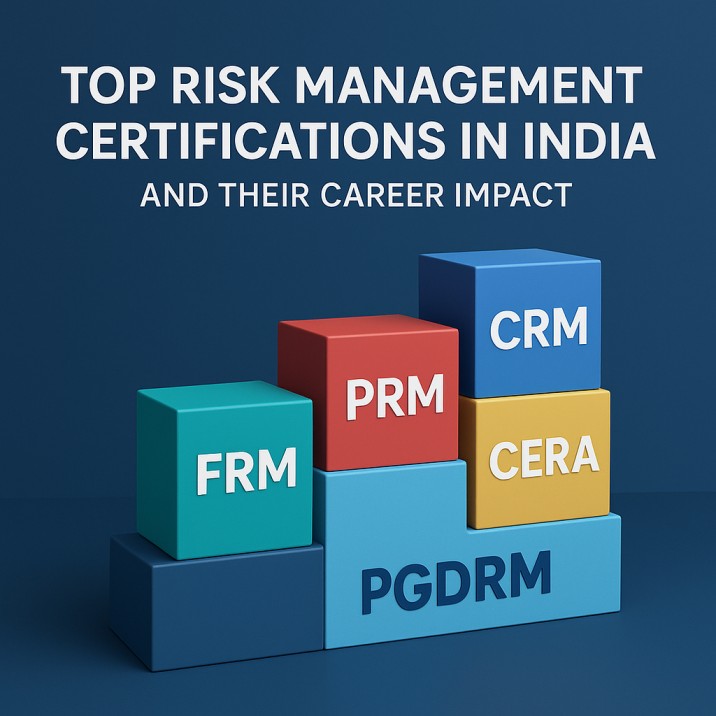
GARP's FRM (Financial Risk Manager) certification — Regarded as the leader in financial risk management education and certification programs.
PRM (Professional Risk Manager) certification by PRMIA — Centers on high-level quantitative and financial modeling.
CERA (Chartered Enterprise Risk Analyst) — Best for those practitioners who wish to execute enterprise-wide risk management.
CIRM (Certified in Risk Management) — Best for risk banking practitioners who are looking for the application of risk management principles.
It is critical to note that each certification varies in emphasis, timeframe, and complexity to ensure that you are on the right path with your career objectives.
How Certification Transforms Your Career Path
Acquiring a certification enhances your resume while sharpening your skills in analysis, decision-making, and leadership. It allows you to move up the ladder from operational roles to strategic ones, where you drive policy and risk management. On top of that, certified professionals tend to make more money and have more international job opportunities.
Banking employers consider certified professionals to be more trustworthy and inventive. As technology advances, certified professionals in fintech risk, cyber risk, and data governance also become more relevant.
FAQs
- What are the prerequisites for a risk management certification?
Most programs require a bachelor’s degree in finance, economics, or a related field. Some advanced certifications like FRM prefer candidates with relevant work experience.
- How long does it take to complete a certification?
Depending on the program, it may take 6 months to 2 years. FRM, for instance, requires two exams and at least two years of relevant work experience.
- Is a certification necessary for promotion in banking risk roles?
While not mandatory, certifications are expected for advanced and specialized roles as they provide proof of your knowledge and commitment to the profession.
-
What are ideal certifications for beginners in risk management?
For beginners, the CIRM or PRM certifications are solid options, as they provide a good mix of theory and practice.

.jpg)
.jpg)
.jpg)
.jpg)
.jpg)