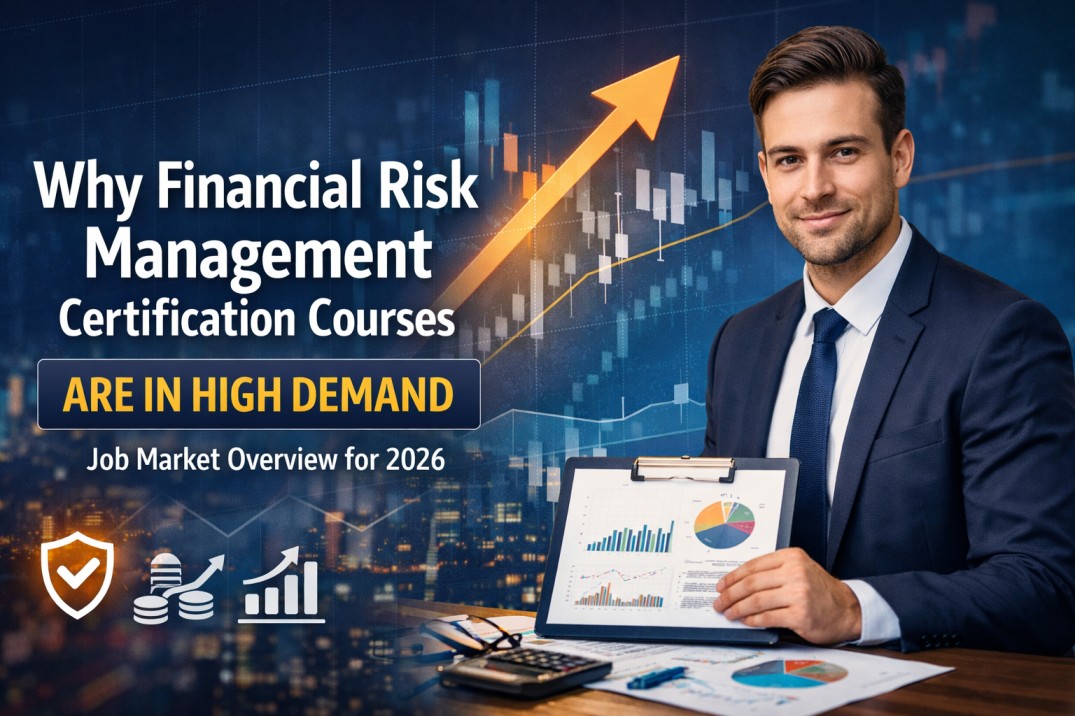
Why Financial Risk Management Certification Courses Are in High Demand
Banking, IT startups, and pretty much every other type of industry have businesses that talk about risk and uncertainty. This is what shows how demand is growing for Risk management Certification Courses, and is expected to grow even more within 2026.
Let us decipher what is actually happening, and what is bringing so many professionals to get these certifications.
More Necessity for Risk Management in 2026
The current global business climate is more dangerous and harder to predict than in any time previously. Day to day challenges include economic instability, cyber threats, changing regulations, and market volatility.
Risk management, while once considered optional by many companies, is now highly regarded and is even used in everyday decision making.
Consider a fintech startup and a new payment app. Before that startup can go live, they have to make assessments of the possibility of fraud, how the payment system is going to be regulated, and any vulnerabilities in the payment system. Without a risk assessment, someone could lose a lot of money and the company could get into legal trouble.
The more complicated things get, the more demand there is for professionals with the expertise to understand the deep driving forces of financial risk.
What Is Driving Risk management Certification Courses And Why Are They Important?
1. Certified Professionals Are More Preferable
These days, recruiters have changed the criteria they use to evaluate candidates. They have shifted from a purely academic perspective and are looking for candidates who have the ability to incorporate risk strategies into practive.
A certification validates that you:
-
Grasp the basics of financial risk analysis
-
Manage both market and credit risks
-
Understand the regulations
An example would be a bank hiring risk analysts and would prefer certified candidates over those who only have an understanding of the theory.
2. Risk Management is Needed Everywhere
Risk management is not the exclusive remit of banks anymore.
By 2026, the following sectors will have employees specializing in risk management:
-
Banking and financial services
-
Insurance
-
Fintech
-
Consulting
-
Healthcare and pharmaceuticals
Risk management is even incorporated within hospitals to mitigate operational and compliance risks associated with the management of patient data.
3. Remarkable Salary Growth and Career Longevity
It is no secret that a primary motivation for practitioners entering this line of work is the financial reward.
Compared to those without certification, risk management certified individuals typically receive a higher remuneration. Offers at the entry-level positions are lucrative, and the remuneration for managerial positions; Risk Manager and Chief Risk Officer is very attractive.
Furthermore, positions within risk management are not susceptible to the same market cycles as other professions; risk management personnel are needed irrespective of the economic environment.
Real-Life Example: The Impact of Certification
Consider two candidates who have applied for the same position at a financial institution
-
Candidate A is a holder of a degree in finance
-
Candidate B is a holder of a degree in finance and is also certified in risk management
There is a likelihood that Candidate B would present a more nuanced approach to dealing with market fluctuations, citing examples of real-life scenarios.
An employer looking to hire will ask, What does the applicant have that the others do not?
The answer: industry certifications.
What a Risk Certification Offers and Teaches
A risk certification is a way to acquire skills that are marketable and useful, such as:
-
Identifying and evaluating risk
-
Ability to create and assess risk models
-
Knowledge of laws governing the financial markets
-
Developing plans to deal with crises
-
Ability to make decisions when the outcome is uncertain
These skills and competencies are not simply theory, and they are not simply academic. They are applied.
Demand and the Role of Technology
The ever-increasing demand for professionals is growing due to the rapid changes in technology
Companies want people who:
-
Can assess risk with the aid of technology
-
Understand the risks of cyber finance
-
Operate digital financial systems
The risk professionals of tomorrow will need to acquire both finance and technology.
Looking into the year 2026
The demand for risk professionals will be high. Based on the trends in the market, we have the following observations:
-
There is a demand for regulated financial markets
-
There is a need for focused, complex, and analytical financial systems
-
Companies have a financial obligation to hire and train professionals.
-
Companies shift towards the sustainability of their operations.
Conclusion
Risk management certification courses are here to stay.
With growing uncertainty in the corporate world, there are opportunities to predict, control, and minimize risk growing in demand.
For those in the finance industry, sufficient risk management certifications will be a valuable asset in 2026, so putting in the effort to get one will be highly beneficial.
Read More: What Courses Make a Financial Engineering Program Stand Out


.jpg)
.jpg)
.jpg)
.jpg)
.jpg)