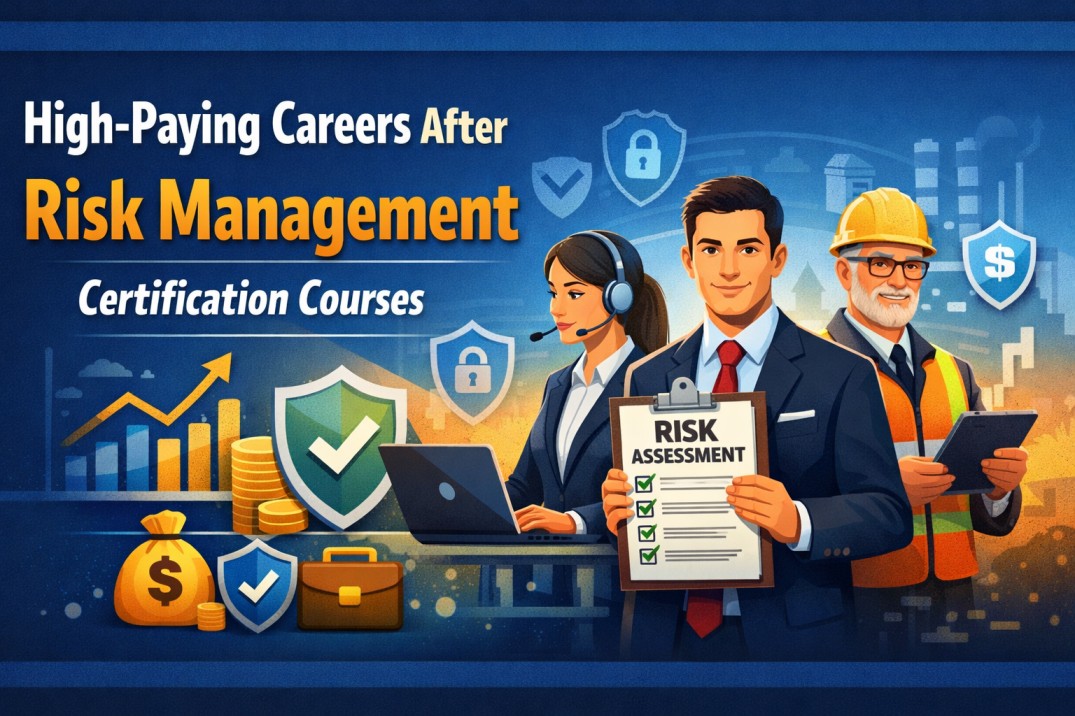
High-Paying Careers You Can Get After Completing a Risk management Certification Courses
With today’s evolving business landscape, companies are emphasizing the importance of risk management more than ever. From loss of revenue to cyber threats, businesses need experts who can identify and mitigate issues ahead of time. This is the reason Risk Management Certification Courses offer a great opportunity for those interested.
If you are looking to identify lucrative job opportunities after the completion of the risk management certification course, keep reading to discover career options that not only offer great pay, but great potential for growth.
1. Financial Risk Manager (FRM)
Financial Risk Managers advise banks, investment companies and corporates on financial risk and control. They look at current market trends, identify and evaluate potential credit risks, and devise strategies for loss control.
For instance, a financial risk manager at a bank that wants to invest in a foreign market will examine possible currency changes and the foreseeable economic situation.
Given the financial industry’s lucrative pay structures, the role is very popular.
2. Credit Risk Analyst
Banks, Non-Banking Financial Companies (NBFCs) and FinTechs need credit risk analysts to assess a potential borrower’s ability to pay back a loan.
For instance, in the case of a large loan request from a business, the credit risk analyst will assess the financial history, existing cash flows, and market position of the entity seeking to gain funding.
With the growth of online lending, analysts are receiving great pay and performance bonuses.
3. Operational Risk Manager
Operational risks may involve system malfunctions, human mistakes, or internal fraud. An Operational Risk Manager keeps business operations running smoothly and safely.
As an example, within a hospital, this position may involve safeguarding against data breaches, or safely storing and securing patient records and information.
It is also a high-paying and stable opportunity, as businesses greatly appreciate and require those who can minimize or eliminate disruptions.
4. Compliance Officer
Every sector is required to follow a set of rules. A Compliance Officer guarantees the company does not operate illegally.
For instance, in the banking industry, compliance officers are responsible for the proper implementation of anti-money laundering (AML) guidelines.
The demand for compliance experts has led to an increase in the willing of organizations to pay compliance experts.
5. Enterprise Risk Manager
Why Risk Management Certification Courses Aid In Your Pursuit Of An Enterprise Risk Manager Position
An Enterprise Risk Manager is more of a holistic thinker. Instead of concentrating on just one category of risks, they assess all of the organization’s potential risks.
Consider a manufacturing business that is planning to expand into another country. The enterprise risk manager would assess the potential political, supply chain, and financial risks associated with the expansion.
This type of position typically offers high remuneration and the potential for lateral advancement into more strategic roles.
6. Cyber Risk Analyst
The rise of cyber threats has led to businesses spending a lot of money on securing their data and systems. A Cyber Risk Analyst is responsible for spotting weaknesses in security systems and safeguarding private information.
Consider an e-commerce company that processes thousands of transactions every day. A cyber risk analyst makes certain that customer data is protected from cybercriminals.
This is one of the highest-paying and fastest growing positions in risk management.
7. Insurance Risk Consultant
Risk specialists at insurance companies determine how much the company should charge customers in premiums and how much the company should pay out for claims. An Insurance Risk Consultant assesses the risks involved in an individual’s health and in the operation of a business as well as in the physical structures that a business insures.
For instance, if a consultant is going to write a large insurance policy for a manufacturing facility, he or she will evaluate the potential for fire and the fire prevention and control measures that have been put in place as well as the number of fires that have occurred.
This position is one that requires a combination of analytical thinking, and dealing with people, which also makes it possible to earn a high income.
Reasons for the High Salaries in These Careers
People who work in risk management make it possible for organizations to not lose money. When a company is able to avoid a risk that could potentially cost millions of dollars, the worth of these specialists becomes evident.
This is the reason employers pay high salaries, provide bonuses, and strive to give employees opportunities for upward mobility. Having skills in data analysis, problem-solving, and decision-making also makes you a strong candidate for employment in any field.
Conclusion
Risk Management Certification Courses can greatly improve your chances of landing some of the most high-paying and prestigious jobs available. This can be in finance, healthcare, insurance, or technology and many other fields.
These jobs do require a strong conceptual and analytical ability, but the most stimulating and rewarding are the ones with the most creative real-world challenges. Managing risk allows you to help organizations stay safe, improve operational effectiveness, and grow their business with a higher degree of confidence.
If you are looking for a career that is very stable, has great growth and earning potential, look no further, risk management is your answer.
Read More: How a Professional Risk Management Certification Can Boost Your Banking Career


.jpg)
.jpg)
.jpg)
.jpg)
.jpg)